Commercial painting

Office painters in Melbourne

Office work is judged on disruption as much as finish. Most programmes run after hours or in staged zones, so desks stay occupied and the business keeps operating.

What we paint in an office

Office work is judged on disruption as much as finish. Most programmes run after hours or in staged zones so desks stay occupied and the business keeps operating.

Work covers the whole workplace — open floors, meeting rooms, kitchens, common areas, bathrooms, ceilings, doors and frames — with patching and making good handled as part of the same programme.

A well-kept workspace is the first thing a visiting client reads about a business. Internally it does something quieter but more useful — a clean, well-presented floor is easier to work in.

Colour selection is part of the service. We will sit down and work through options rather than sending a chart.

Includes

  • Open-plan floors and meeting rooms
  • Kitchens, common areas and bathrooms
  • Patching and making good
  • After-hours and staged programmes
  • Colour consultation

Office work at scale

Eleven occupied office sites for a single client, under one programme.

  • Repainted commercial office interior, walls and ceiling finished in white

    Across metropolitan Melbourne

    Repaint of 11 NDIS offices across Melbourne

    Repainting eleven separate office sites for one client, each an occupied workplace, under a single contract with fixed budget accountability and consistent standards across every location.

What an office repaint has to work around

An office repaint is scoped by how much of the floor can be released at once, not by floor area. A single open floor handed over for a weekend moves fast. The same area released as four zones across four weekends is the same amount of painting spread over four times the elapsed period, with four sets of set-up and pack-down inside it. Both are legitimate; they cost differently, and the difference should be visible before the choice is made.

The equipment is rarely the problem — the personal effects are. Monitors, docks and cabling are straightforward to cover or move, but desks carrying papers, mugs, plants and framed photographs cannot be cleared by a painting crew without someone eventually asking where something went. A floor where staff have cleared their own desks before the programme starts runs measurably faster than one where they have not.

Comms rooms, floor boxes and data cabling are treated as exclusion zones unless the IT team says otherwise. So are anything sprinkler-related and any device on a ceiling. Marking those out at the site assessment is quicker than discovering them at eleven at night with masking already up.

Low-VOC systems are standard for occupied workplaces, but ventilation is what actually clears a floor before staff return. That ventilation window is a real constraint on the programme, and it is one of the main reasons larger floors are done across a weekend rather than overnight.
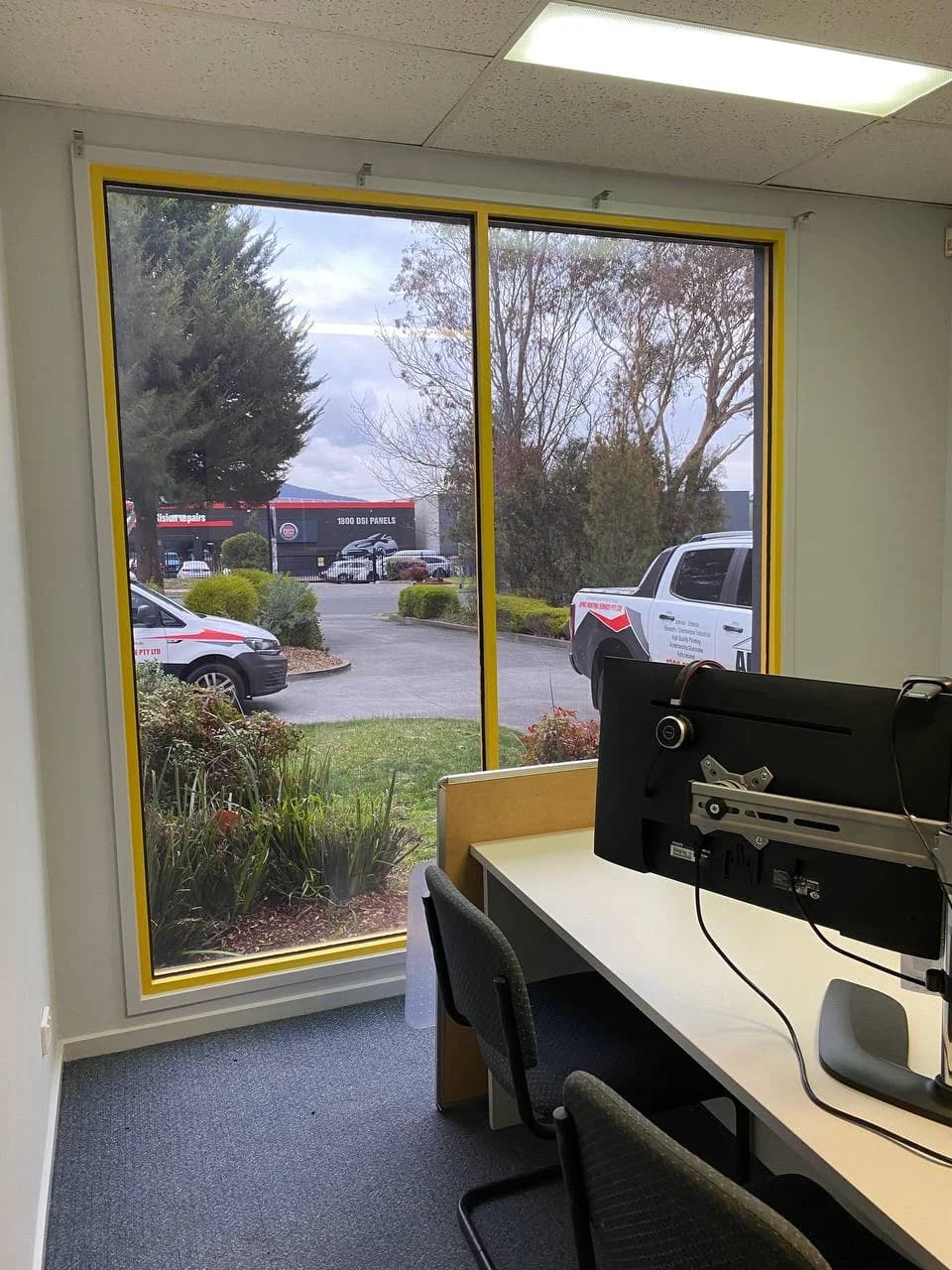
The surfaces in an office fit-out

An office is not one surface repeated. These take different systems and different amounts of preparation time, and a quote that treats them as one number is hiding something.

  • Walls in circulation routes

    Corridors, lift lobbies and the walls beside desks take chair, bag and trolley contact. A washable system in those runs and a standard finish elsewhere gets more life from the same budget than specifying the whole floor up.

  • Ceiling grid and exposed services

    Grid, ductwork and conduit spray well. Acoustic tiles are a judgement call, because coating them can reduce their acoustic performance — on a floor where that matters, replacing tiles and coating the grid is usually the better answer.

  • Doors, frames and joinery

    These are the surfaces people actually touch, and they are what a visiting client notices. They take a harder-wearing system and more preparation time per square metre than any wall on the floor.

  • Kitchens, bathrooms and end-of-trip

    Wet and high-traffic amenities are specified for moisture and frequent commercial cleaning, not as an extension of the office wall system.

  • Patching and making good

    Removed signage, old fixings, previous partition lines and cable penetrations all have to be made good before coating, and on a floor that has had several tenancies this is often the largest preparation item.

  • Make-good at lease end

    A make-good scope is written against the lease, not against taste. Establishing exactly what the lease requires before quoting prevents both over-scoping and a failed handover inspection.

Office painting questions

Can you paint the office after hours so nobody has to move out?

That is how most office programmes run. Work happens overnight or across a weekend, and each area is cleaned down and returned before the next working day. Where a full after-hours programme is not practical, the floor is split into zones and staff are relocated one zone at a time rather than the whole floor being emptied.

What happens to computers, monitors and cabling?

Equipment is either moved clear by your team or covered and worked around, and that decision is made before the programme starts because it changes the sequence. Data cabling, floor boxes and comms rooms are treated as exclusion zones unless your IT team says otherwise. The practical advice is to have desks cleared of loose items — the equipment itself is straightforward, the personal effects are what slow a floor down.

Will the office smell of paint when staff come back?

Low-VOC systems are standard for occupied workplaces and they reduce it substantially, but ventilation is what actually clears a floor. Programmes are built so that coated areas get a ventilation window before staff return, which is one of the reasons weekend work is common for larger floors.

Can you paint acoustic tile ceilings and exposed services?

Ceiling grid and exposed services can be sprayed. Acoustic tiles themselves are a judgement call: coating them can reduce their acoustic performance, so on a floor where that matters the usual answer is to replace tiles rather than paint them, and to coat the grid instead. It is worth deciding that before the quote rather than after.

How long does an office floor take?

The driver is how much of the floor can be released at once, not the floor area. A single open floor released entirely over a weekend moves quickly; the same area released as four zones across four weekends takes four times as long in elapsed weeks for the same amount of work. Both are priced at the site assessment so the trade-off is visible before you choose.

Repainting your workplace?

Tell us the floor area and the hours we are allowed in, and we will come and look.