Commercial painting

School and childcare painting in Melbourne

Painting a school means working around a campus that never really stops. Term dates, exam periods, playground access and the presence of children all shape when work can happen and how a site is set up each day.

What shapes work in this sector

The operational constraints that decide how the programme is built.

  • Staged around the school calendar

    Most work is sequenced into term breaks and holiday periods. Where that is not possible, zones are isolated and handed back progressively so teaching continues.

  • Personnel clearances

    Staff working on education sites hold Working with Children Checks. Site inductions and sign-in procedures are followed as the school requires.

  • Access across varied building heights

    Campuses mix single-storey classrooms with taller halls and gymnasiums, so access is planned per building — ladders, scaffolding or an EWP as each area requires.

  • Neighbouring site coordination

    Schools frequently sit alongside childcare centres or active construction. Boundaries, deliveries and shared access are coordinated with the other operators.

What the work involves

Schools wear out at hand height. Corridors, hall walls, door frames and locker runs take constant contact all day, and the finish that survives it is a washable, scrubbable system rather than a flat wall paint chosen on colour alone. Specifying by wear zone — durable systems at contact height, standard finishes above — is usually what decides whether a repaint still looks like a repaint three years later.

A two-week term break is about ten working days once access, set-up and pack-down are counted. That is enough for a classroom block or a wing of corridors; it is not enough for a full campus exterior. Larger scopes are normally split across consecutive breaks with each stage handed back complete, so the school never returns to a half-finished building.

Buildings put up before the 1970s can carry lead-based paint under later coats. Where the age of the building makes that plausible, the existing coating is assessed before any sanding or scraping starts, and preparation is planned so dust is contained rather than released across a site children use. That containment is a scheduling question as much as a safety one, because it takes time that has to be in the programme.

Outdoor structures are a separate specification. Play equipment, shade posts, ball walls and line marking face UV, impact and cleaning that interior systems are not built for, and they usually need a protective system rather than a decorative one. Court and playground line marking is also a wear item on its own cycle, not something that renews with the walls.
Evidence

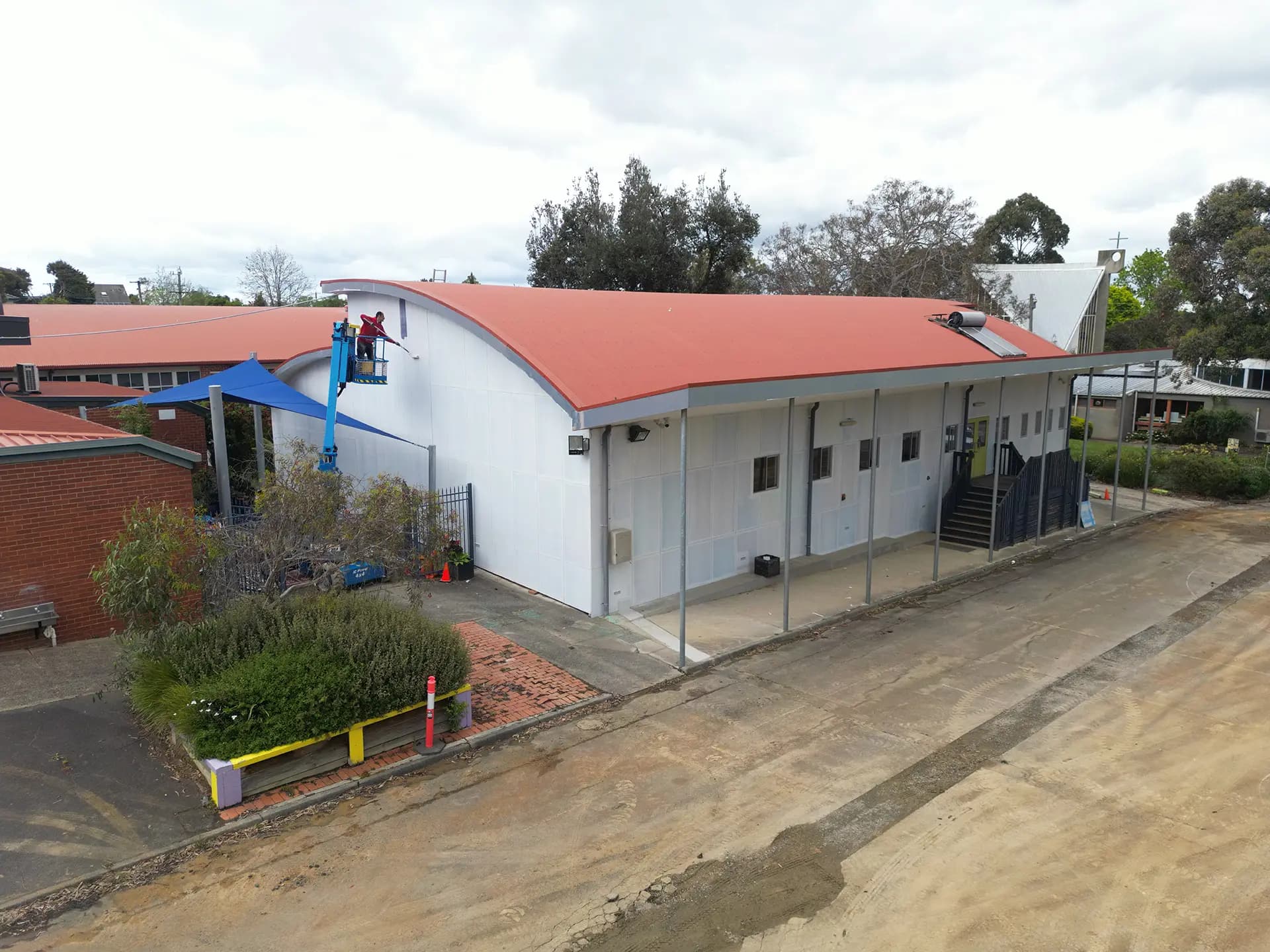
  • Repainted exterior brickwork and rendered walls at Emmaus College in Vermont

    Vermont, Victoria

    Emmaus College school repaint, Vermont

    A full interior and exterior repaint across a campus that stayed open throughout. The site had to keep running while work moved between zones, with access shared alongside an active construction site on one boundary and an operating childcare facility on another.

Education & childcare painting questions

Can painting happen during term time?

Some of it. Classroom interiors and anything generating dust or odour are normally sequenced into term breaks. External elevations, fence lines and areas that can be fully isolated from student movement can often run during term with the zone fenced and handed back each day. The split is decided at the site assessment rather than assumed.

How do you handle older buildings that may have lead paint?

The existing coating is assessed before preparation begins wherever the building’s age makes lead-based paint plausible. If it is present, preparation is planned around containment — controlled removal, sheeting, and waste handled rather than swept up — and that containment time is built into the programme instead of discovered halfway through it.

What finish is used in classrooms and corridors?

Washable, scrubbable systems in the areas that take contact, which in practice means corridors, hall walls, door frames and anything at hand height. Ceilings and high wall areas do not take the same wear and do not need the same system, so specifying a whole room to the highest grade usually spends money where it will not show.

How far ahead should a school book a repaint?

Far enough that the scope is agreed before the break rather than during it. The working window is fixed by the calendar, so the site assessment, the written scope and any lead paint assessment need to be finished in advance. The break itself is for painting, not for deciding what is being painted.

Related

Commercial work rarely sits in one sector. These are the closest neighbours to education & childcare.

Other sectors

Talk to us about education & childcare work

Tell us the site, the constraints and when we are allowed on it.